Muse Glimmer: Meta's 30B Open-Weight Local Agent Model Explained
Meta's Muse Glimmer is an open-weight model for local agent workflows, with image input, tool use, an under-20-GB quantized checkpoint, and speculative decoding.
Published: Last checked:
 Lucky YaduvanshiRankLLMs Editorial
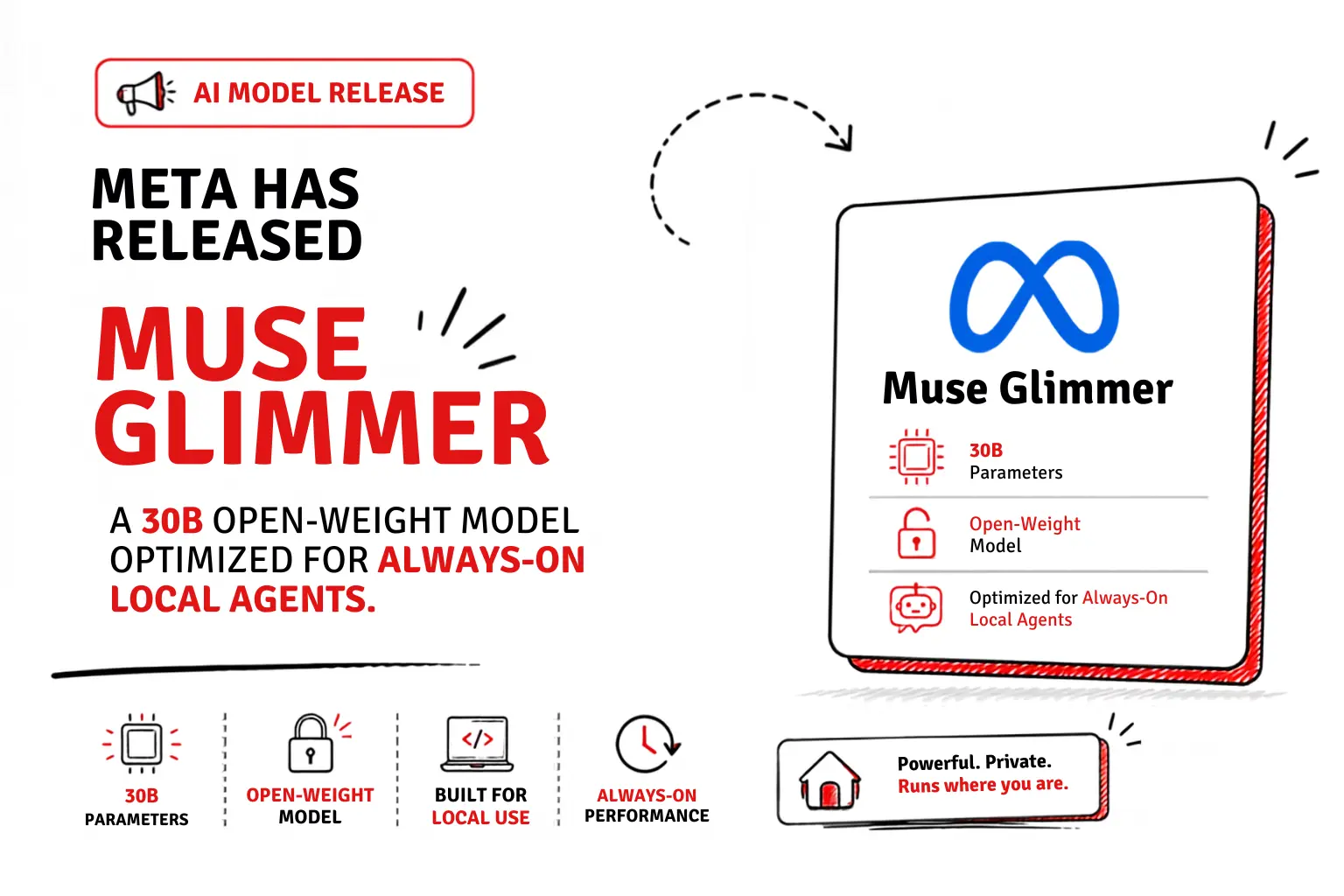
Meta's Muse Glimmer is an open-weight model for local agent workflows, with image input, tool use, an under-20-GB quantized checkpoint, and speculative decoding.
Written and checked by the RankLLMs editorial team. See theeditorial policy.
Muse Glimmer is Meta’s approximately 30-billion-parameter model for local agent workflows. Its model card gives the more precise total as about 29.6 billion parameters, including a dedicated vision encoder, and lists a 131,072-token-plus context length. It takes text and image input and generates text. Meta lists the released artifacts under Apache 2.0; inspect the terms attached to derivatives or repackaged checkpoints separately. The model card describes tool use, multi-step reasoning, and recovery from failed tool calls as design goals, not guarantees for every agent scaffold.
Local deployment and memory
Meta says its approximately 4-bit quantized language model is under 20 GB and is intended to leave room for a KV cache, perception encoder, and speculative decoding drafter in a 24 GB or 32 GB memory envelope. This is a vendor estimate for the documented quantized setup. It is not a guarantee that every checkpoint, context size, serving runtime, or operating system will fit within 24 GB. The total parameter count and active parameter count also do not equal the memory required for model weights; the quantized checkpoint size is the more useful figure for planning.
Meta reports a K-Quant 17 GB model paired with a quantized DFlash drafter at 233.4 tokens/second on an RTX 5090, 37.8 on an M4 Max, and 50.2 on an M5 Max. Its baseline figures without speculation are 74.9, 23.7, and 26.6 tokens/second respectively. These are vendor measurements averaged across a diverse prompt set at batch size one with greedy decoding; Meta used llama.cpp for RTX and ExecuTorch for the Macs. They do not predict performance on other hardware, runtimes, context lengths, or sampling settings.
Meta names integrations for llama.cpp, MLX, and ExecuTorch as expected to arrive after launch. It also lists partners and serving frameworks in its release materials. Check the developer docs and the model repository for the actual supported formats and setup steps before choosing hardware.
Capabilities and limits
Meta describes support for interleaved text and image input, schema-based tool calls, and configurable reasoning effort. Its model card publishes results including 75.5 on MCP Atlas Public, 74.6 on DeepSearch QA, 76.0 on SWE-Bench Verified, and 51.2 on SWE-Bench Pro. These are separate evaluations with different tasks and setups; they should not be collapsed into one coding score or treated as a prediction for a user’s repository. Meta links its evaluation report for further setup details.
The quantized language model is listed at under 20 GB, with a 24 GB or 32 GB target envelope depending on the quantization. Weight-file size is only one part of memory use: runtime buffers, the KV cache, and the perception encoder also need space. Meta reports 1.0% average degradation on its 15-benchmark accuracy set for the K-Quant-17GB variant, but that aggregate does not rule out larger changes on an individual task.
A local model can keep inference on a device when the runtime and connected tools are configured locally. That alone does not make an agent private or safe: tools may access files, networks, or services, and logs may retain sensitive data. Review the scaffold permissions and data handling.
Meta’s memory targets describe specific quantized configurations; they do not establish that every consumer GPU or Apple Silicon Mac can run the model at a useful context length. Its model card also recommends application-specific safety testing and additional guardrails for systems connected to tools, especially before actions with real-world effects.
Getting started
Download the weights and follow Meta’s current developer documentation and release announcement. The official model card includes model specifications, evaluation details, hardware measurements, and supported serving examples. Start with a short, non-sensitive task and measure memory use, generation speed, tool reliability, and task quality on the hardware you plan to use.
For broader open-weight comparisons, see our Open-Source LLM Guide and AI Model Leaderboard.
Frequently Asked Questions
What is Muse Glimmer?
Muse Glimmer is a 30-billion-parameter open-weight model from Meta Superintelligence Labs designed for always-on local agent workflows such as tool use, coding, multimodal tasks, and long-horizon execution.
Can Muse Glimmer run on a consumer GPU?
Meta says its approximately 4-bit quantized language model is under 20 GB and describes a 24 GB or 32 GB memory envelope for that setup. Actual fit depends on context length, runtime, cache, and other components.
What license does Muse Glimmer use?
Meta's official Muse Glimmer model card lists the released artifacts, including full-precision weights, 4-bit weights, the DFlash drafter, and perception encoder, under Apache 2.0. Review the license and terms attached to any derivative or repackaged checkpoint you use.
Can Muse Glimmer run on a Mac?
Meta reports measuring its quantized model on MacBook M4 Max and M5 Max systems, as well as an RTX 5090. This does not guarantee performance or compatibility on every Mac or PC.
Is Muse Glimmer multimodal?
Meta says Muse Glimmer has a dedicated perception encoder and accepts interleaved text and image inputs, including screenshots, charts, and documents.
Source links for data and claims discussed in this article are listed below. Refer to each source for its current figures and methodology.
Lucky Yaduvanshi(luckyyaduvanshi.in →)
Founder of RankLLMs • AI Researcher & Software Engineer focusing on LLM benchmarking, DevOps, and autonomous coding agents.
Recommended Reading
Related by topic and recency.
Alibaba Model Studio Token Plan: Pricing Structure and Claude Code Integration
Review of Alibaba Model Studio Token Plan terms, Singapore availability, Personal and Team quotas, API compatibility, and billing checks before subscribing.
Tencent Hy4 Preview: 770B MoE Architecture and 1M Context Window
Tencent Hy4 preview has 770B total and 49B activated parameters, a 1M context window, published FP8 checkpoints, deployment recipes, and an Apache 2.0 license.
Claude Sonnet 5: Permanent $2/$10 Pricing and Developer Impact
Anthropic made Claude Sonnet 5 API pricing permanent at $2 per million input and $10 per million output tokens. See a cost calculation with cache assumptions.